Thought Leadership
The Brain's Missing Vital Sign
Why Psychiatry’s Measurement Crisis Is Digital Health’s Biggest Arbitrage Opportunity
- Mental Health
- Psychiatry
- Artificial Intelligence
- Neuroscience
- Healthcare Technology
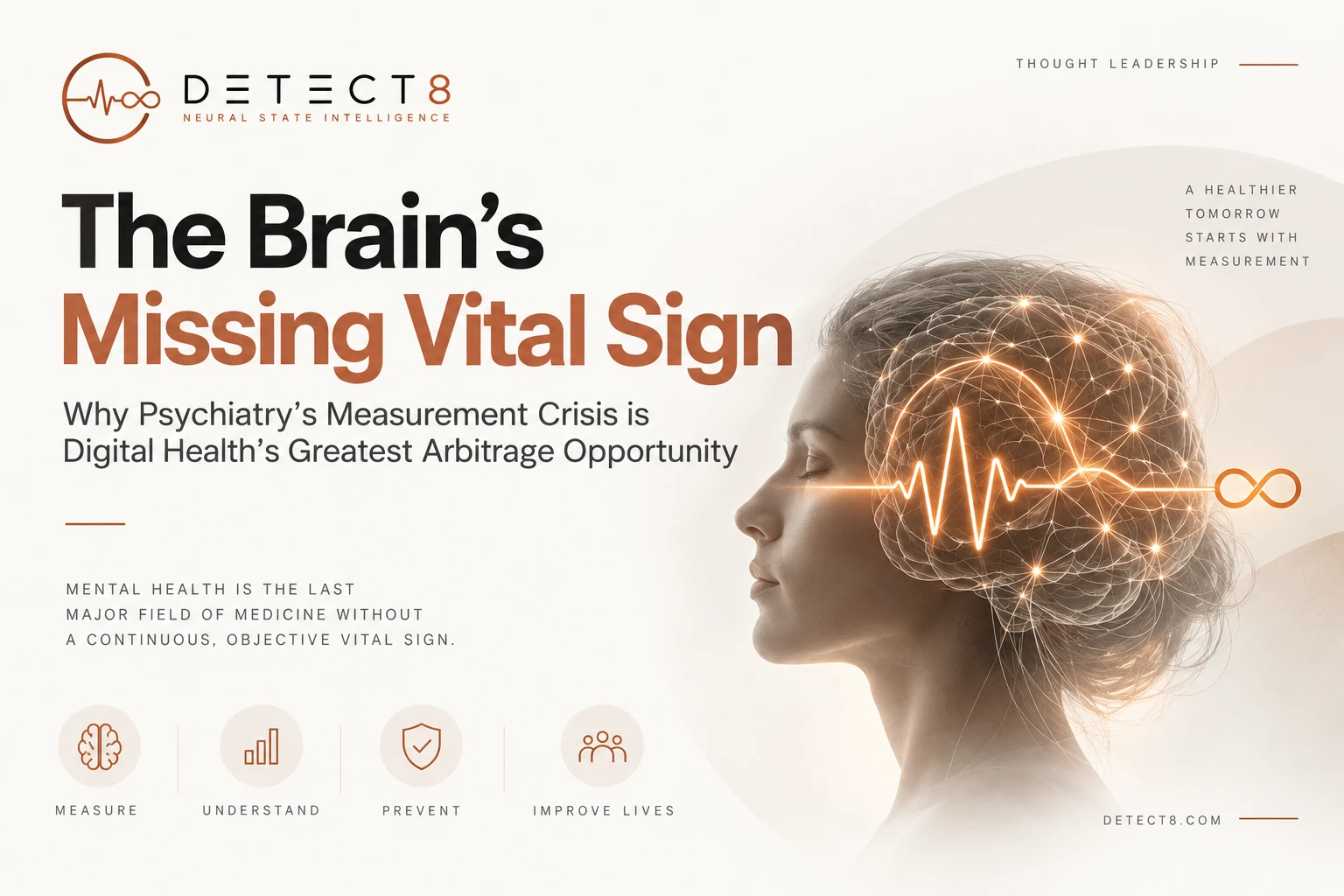
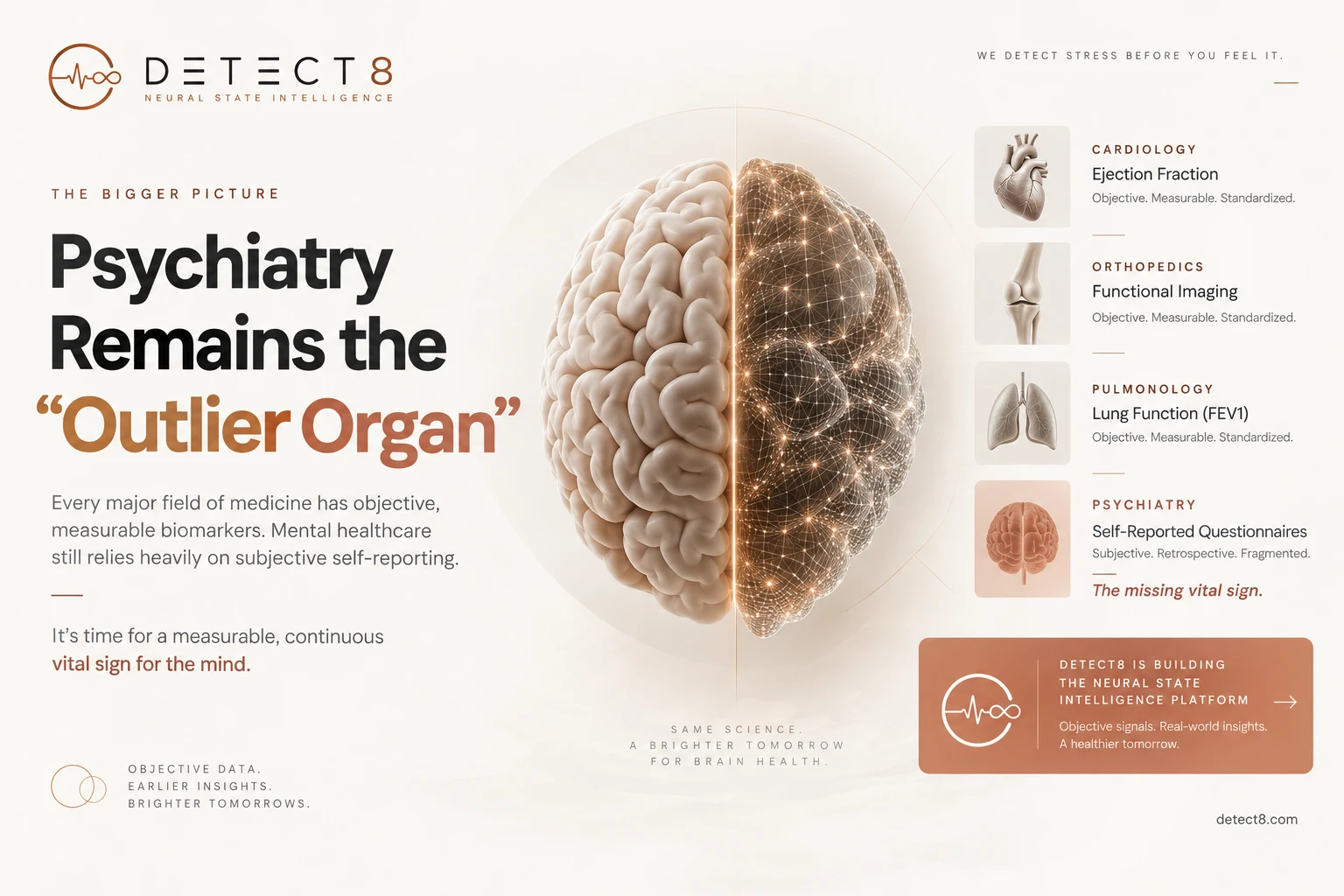
Psychiatry is the outlier organ. Cardiology has ejection fraction. Orthopedics has functional imaging. Mental healthcare still runs on the subjective, retrospective self-reporting of the patient: instruments like the PHQ-9 that capture a memory of how someone felt rather than any real-time read on the biology underneath it. For health systems and institutional investors, that’s not just a clinical inconvenience. It’s the reason mental health has never had a mental health vital sign the way cardiology or orthopedics do, a structural bottleneck that keeps psychiatry from scaling the way every other specialty already has.
You can see the bottleneck most clearly on a hospital’s own books. Psychiatric units routinely recover only around 65% of their operating costs. A big part of that shortfall comes from “grid staffing”: flat ratios that don’t flex with how sick a given patient actually is, because there’s never been a number to flex against. No objective measure means no precise resourcing, which means unpredictable outcomes, which means the whole department carries more valuation friction than it should. What’s shifting that picture is a genuinely new piece of biology: a 2026 finding out of NYU’s Rory Meyers School of Nursing showing that epigenetic age acceleration in monocytes tracks with hopelessness and anhedonia in close to real time. That’s the kind of “gold standard” signal that digital indicators have been missing something to calibrate against. Detect8’s position is that this is the raw material for the vital sign psychiatry has never had, and the asset that gets built by turning it into something clinical-grade.
1. The WHO Numbers: Fragmentation as Market Friction
The mental health surge since the pandemic has forced new infrastructure into existence, but the response is still badly fragmented. WHO/Europe’s 2026 figures put the scale in stark terms: 143 million people across Europe are currently affected by a mental health condition, and prevalence is up 25% since before the pandemic. A scoping review spanning 75 studies found something almost as striking: there are 450 separate mental health indicators currently in circulation. Dr. David Novillo Ortiz and Dr. Ledia Lazeri call this a scarcity of system-level indicators, and the practical effect is a gap in response: too many ways of counting, not enough ability to act on what’s counted. From where an investor sits, those 450 indicators are exactly what valuation friction looks like on the ground. Detect8’s strategy is to use biological markers, the NYU monocyte finding among them, as ground truth to pull those fragmented metrics into a single standard. Collapse 450 indicators into one, and you’ve built a liquidity layer for mental health data: something that moves from being a fragmented liability to a tradable, scalable clinical asset.
2. Earning Trust: Three Pillars Behind a Continuous Brain-Health Metric
In 2026, trust is the currency that gets digital health adopted. Getting from passive monitoring to something a clinician or an investor can actually rely on takes more than a good sensor: it takes rigor that doubles as risk mitigation.
Pillar A: Mitigating Generational Alpha Decay
Clinical scales have a fragility problem: Flake and Fried have called it “measurement schmeasurement,” and it’s a fair description. Language drifts across cohorts: what the Silent Generation means by “depressed” isn’t what Gen Z means by it, and that drift alone can wreck a longitudinal study. Guarding against this kind of decay means clearing three specific bars. Configural invariance means the underlying structure of the construct holds steady across groups. Metric invariance means the strength of the relationship between items stays consistent group to group. Scalar invariance means a difference in average score reflects a real difference in the trait, not a quirk of how one cohort answers questions.
Pillar B: Preserving Construct Validity via PCT-GAN
Training on synthetic data creates its own trap. Unconstrained generative models like TVAE tend to smooth over natural variation in survey responses (what shows up as “homogeneity bias” or posterior variability compression), and the tell is an inflated Cronbach’s alpha that looks like better consistency but is actually a sign the psychometric structure has been corrupted. Detect8 uses PCT-GAN (Shao et al., 2026), which builds in factor-reconstruction and correlation-preservation losses specifically to hold clinical structure in place. The improvement is real: PCT-GAN cut inter-item correlation deviation by 15% versus TVAE and by 31% versus CTGAN, while keeping the latent factor structure of validated scales like the DASS-42 intact. That’s what makes the resulting synthetic data trustworthy enough for secondary research rather than a source of quiet contamination downstream.
Pillar C: Self-Auditing Infrastructure for Financial Digital Phenotyping
Under the EU AI Act, digital phenotyping is classified as high-risk, which means static compliance paperwork doesn’t cut it anymore. Detect8 follows the approach Adedeji et al. (2026) laid out for financial digital phenotyping: an automated ethical oversight agent, built on deontic temporal logic and the Z3 SMT solver, that functions as a real-time compliance officer rather than a one-time checklist. In practice, that means the system can tell the difference between an identifying field like a merchant name and a purely behavioral signal like spending velocity, and it blocks collection outright when consent doesn’t cover it or the data isn’t necessary for the stated research purpose. That’s what cuts legal exposure and speeds up regulatory clearance at the same time.
3. The Precision Paradigm
Digital health is shifting away from access-level software (teletherapy platforms and the like) toward measurement-level clinical standards. Capturing brain-health metrics that are objective, ethically sound, and psychometrically valid is the biggest untapped arbitrage opportunity left in healthcare.
Resolve the measurement crisis, consolidate 450 fragmented indicators into one standardized liquidity layer, and psychiatry stops being a reactive discipline and becomes a proactive, precision-based science. Detect8 is building toward that standard: the clinical one and the financial one at once. For an investor, the takeaway is straightforward: the value isn’t only in the care that gets delivered. It’s in the precision of the data that decides how that care gets delivered in the first place.
If your organization is weighing where objective measurement could change staffing or outcomes, we’d welcome the conversation, including where the evidence is still developing. Learn more about how we are building this measurement layer at Detect8.
References
- 1. Marker of Biological Aging Linked to Some But Not All Symptoms of Depression · NYU Rory Meyers College of Nursing, May 2026
- 2. New study reveals gaps in how mental health is measured in European Region · WHO/Europe, June 2026
- 3. Mapping of mental health indicators in the WHO European region: a scoping review · PMC, 2026
- 4. Measurement Schmeasurement: Questionable Measurement Practices and How to Avoid Them · Flake & Fried, Advances in Methods and Practices in Psychological Science, 2020
- 5. Beyond classification metrics: a psychometric-aware benchmark for data augmentation in imbalanced student mental health surveys · Shao et al., Frontiers in Digital Health, 2026
- 6. A Computational Ethical Framework for Financial Digital Phenotyping for Mental Health · Adedeji et al., arXiv, 2026